
Read Ohio County Property Tax Records
Two Ohio County offices split the tax record. The PVA fixes the parcel identity, owner, and assessment. The Sheriff collects the current annual bill. After the statutory collection period closes, an unpaid prior-year bill moves to the County Clerk. Before treating one screen as the whole property tax record, note which office created each field.
| Record field | Meaning | Official source |
|---|---|---|
| Parcel and assessed value | The tax-roll identity and fair-cash-value assessment | Ohio County PVA |
| Owner and mailing address | The roll name and address used for tax correspondence | Ohio County PVA |
| Exemption indicator | Whether qualifying relief affects taxable exposure | Ohio County PVA |
| Current bill and status | Annual amount, payment stage, and collection information | Ohio County Sheriff |
| Delinquent prior-year bill | A bill transferred after the Sheriff's collection period | Ohio County Clerk |
Fair cash value is Kentucky's assessment standard. That standard does not turn a tax assessment into a recent arm's-length sale price, and the two should never be confused. The size of the bill reveals nothing about title. A deed and its consideration, when shown, belong to the Clerk's land-record trail.
Ohio County's January 1 Tax Snapshot
January 1 anchors the assessment date. Kentucky Department of Revenue guidance drives the local calendar. Real property is revalued every year. Inspections come at least once every four years. Because the roll is a snapshot, a later sale, building change, or deed may not match that year's notices.
The PVA roll values parcels rather than tracking closings. Ohio County publishes no deed-to-roll update lag. After a sale, compare the latest recorded deed, since the Clerk's recording date and grantee are newer evidence than the roll's owner line.
The Kentucky DOR's real-property assessment page explains the state process behind the local roll.
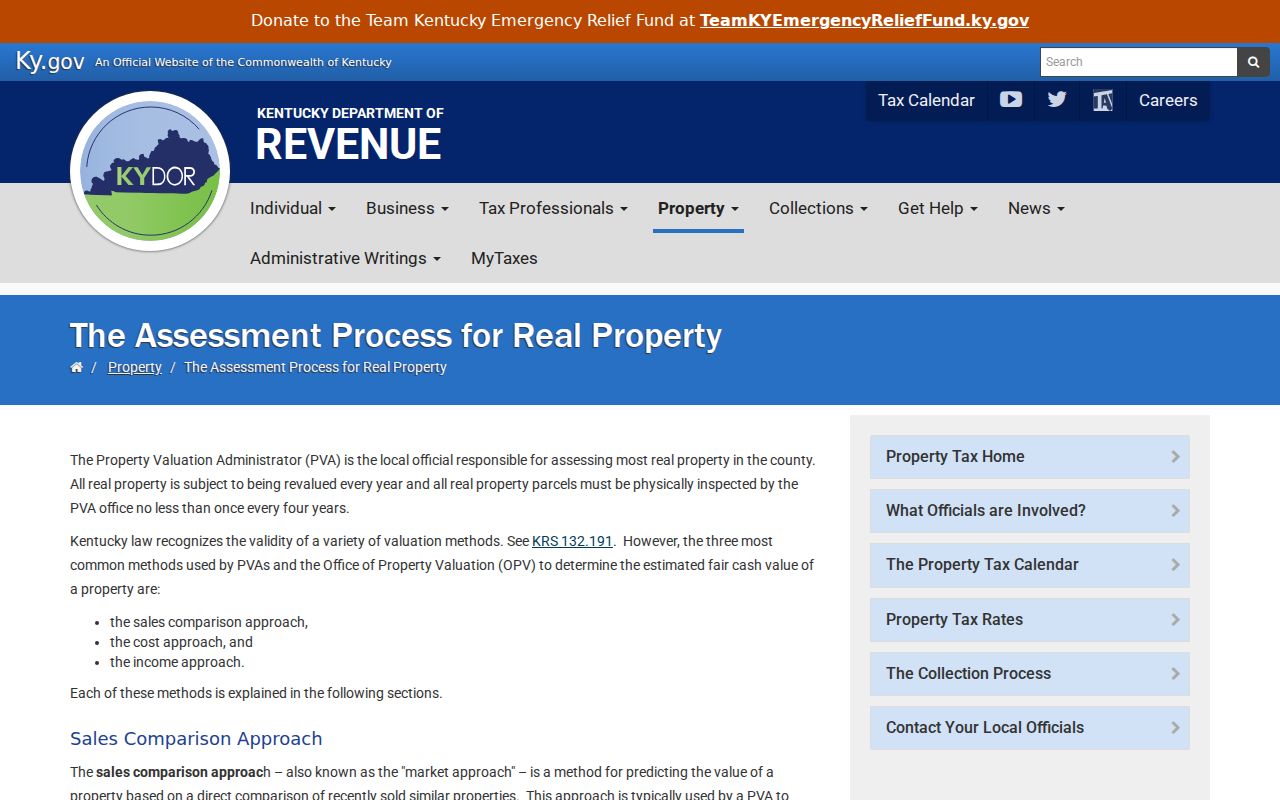
The PVA handles each annual valuation under state guidance, yet the parcel card is still the place to confirm a specific Ohio County assessment.
Note: Save every figure with its assessment year attached, because one parcel can show different values and owners from roll to roll.
Search the Ohio County PVA Tax Roll
The official local route is the Ohio County PVA qPublic application. Search options include name, address, parcel ID, alternate ID, and state or county selection. Keep address abbreviations and parcel punctuation exact. Sloppy entries are the usual cause of missed results.
| Search key | Input | Use |
|---|---|---|
| Owner name | Surname and given-name variants | Find parcels tied to a person or entity |
| Location address | Street number, route, suffix, direction | Match the physical parcel |
| Parcel ID | Exact identifier, including spaces or symbols | Carry one parcel across offices |
A successful captured view of the qPublic platform-level search shows those available search modes.

Treat the search screen as a field guide. The PVA office confirms the current parcel card and value fields.
Ohio County Property Tax Bill Calendar
The Ohio County Sheriff tax page lays out the local collection sequence. Bills come due October 1. Early payment earns a 2% discount through November 1. Face value runs November 2 through December 31. The page then lists a 5% penalty for January 1 through January 31 and a 21% penalty through April 15.
| Period | Bill stage | Keeper |
|---|---|---|
| Oct. 1 to Nov. 1 | 2% discount | Sheriff |
| Nov. 2 to Dec. 31 | Face value | Sheriff |
| Jan. 1 to Jan. 31 | 5% penalty | Sheriff |
| Through Apr. 15 | 21% penalty stage | Sheriff |
| After Apr. 15 close | Unpaid preceding-year bills transfer | County Clerk |
Rates and payment status can shift from one tax year to the next, so the bill itself governs the amount due. The Sheriff's page also carries payment instructions.
Look Up an Ohio County Tax Bill
A bill check is a quick handoff between offices. Match the tax bill to the PVA parcel first, then read its collection stage with the Sheriff or Clerk.
- Search the PVA roll by the situs address and copy the parcel ID exactly.
- Use the Sheriff's instructions for the current annual property tax bill and payment stage.
- Ask the Sheriff for a duplicate by mail, fax, or email during collection if the bill is missing.
- For an unpaid preceding-year bill after April 15, check with the County Clerk.
- Assessed value
- The PVA's value for the property-tax roll under Kentucky's fair-cash-value standard.
- Levy or tax rate
- The rate applied by a taxing authority; the official bill controls the actual charge.
- Homestead exemption
- Qualifying relief administered through the PVA that can affect taxable exposure.
- Tax lien
- A public claim tied to unpaid taxes, distinct from a current bill that has been paid.
Redirecting a duplicate bill is temporary. The PVA maintains the mailing address, so any permanent correction belongs there.
When Ohio County Delinquent Taxes Change Hands
Unpaid preceding-year property tax bills transfer from the Sheriff to the County Clerk at the close of business on April 15. Penalties and interest come with them. The office change matters. A person still asking the Sheriff about a transferred bill may be looking in the wrong place. The parcel number stays the same.
The Kentucky DOR property-tax page says 2025 delinquent tax lists are scheduled for June 30, 2026. No separate Ohio County publication or local fee change appears yet. Confirm the live list and balance with the Clerk. An old notice cannot establish current delinquency.
Note: Delinquent-tax status can matter in a due-diligence review, but it does not replace the deed index or a professional title examination.
Ohio County Exemptions Stay With the PVA
Homestead relief starts with the Ohio County PVA. The Sheriff does not decide who qualifies. That office simply bills and collects from the certified tax roll. An exemption is not a lower market price. It changes the taxable treatment on the assessment side. It does not change the deed owner either. Kentucky's fair-cash-value standard still governs valuation, so relief on the parcel card should be read as a tax adjustment rather than an opinion of what the property would sell for.
Check the assessment year on the parcel card. Check the exemption indicator too. Comparing tax bills across different years without confirming both details is an easy way to misread the record. If the roll is missing expected relief, gather the parcel number. Bring the current proof requirements to the PVA. Arthur D. Leach's PVA office is at P.O. Box 187, 301 South Main Street, Hartford, KY 42347. The published telephone is (270) 298-4433, with fax (270) 298-4435, and office hours are 8:00 a.m. to 4:00 p.m. Central, Monday through Friday. Ask the staff for the current form and proof rules, since local checklist items vary.
Contest an Ohio County Property Assessment
Start with a conference at the PVA. Kentucky requires that step during the inspection period. The DOR property-tax calendar sets the annual dates. If the conference resolves nothing, the taxpayer petitions the local board no later than one workday after the inspection period closes. KRS 133.120 supplies the appeal-after-conference rule.
Form 62F003 asks for taxpayer and property identification, plus confirmation that the PVA conference happened. It also wants the taxpayer's opinion of fair cash value, the reasons for disagreement, evidence, a signature, and filing details. Good evidence is concrete. Think physical characteristics, construction costs, insurance information, and sales listings. Confirm the exact Ohio County counter date for the year at issue, since it can shift from one assessment cycle to the next.
The conference itself should stay focused on parcel facts. Keep the value evidence tied to the assessment year. Kentucky DOR recognizes sales comparison, cost, and income as appraisal approaches, and the right fit depends on the property. Photos, measurements, repair records, and comparable sales carry more weight than a bare claim that the bill is too high. Hold onto proof that the conference occurred, because the appeal form asks for it. Check the current Kentucky property-tax calendar before filing an Ohio County appeal.
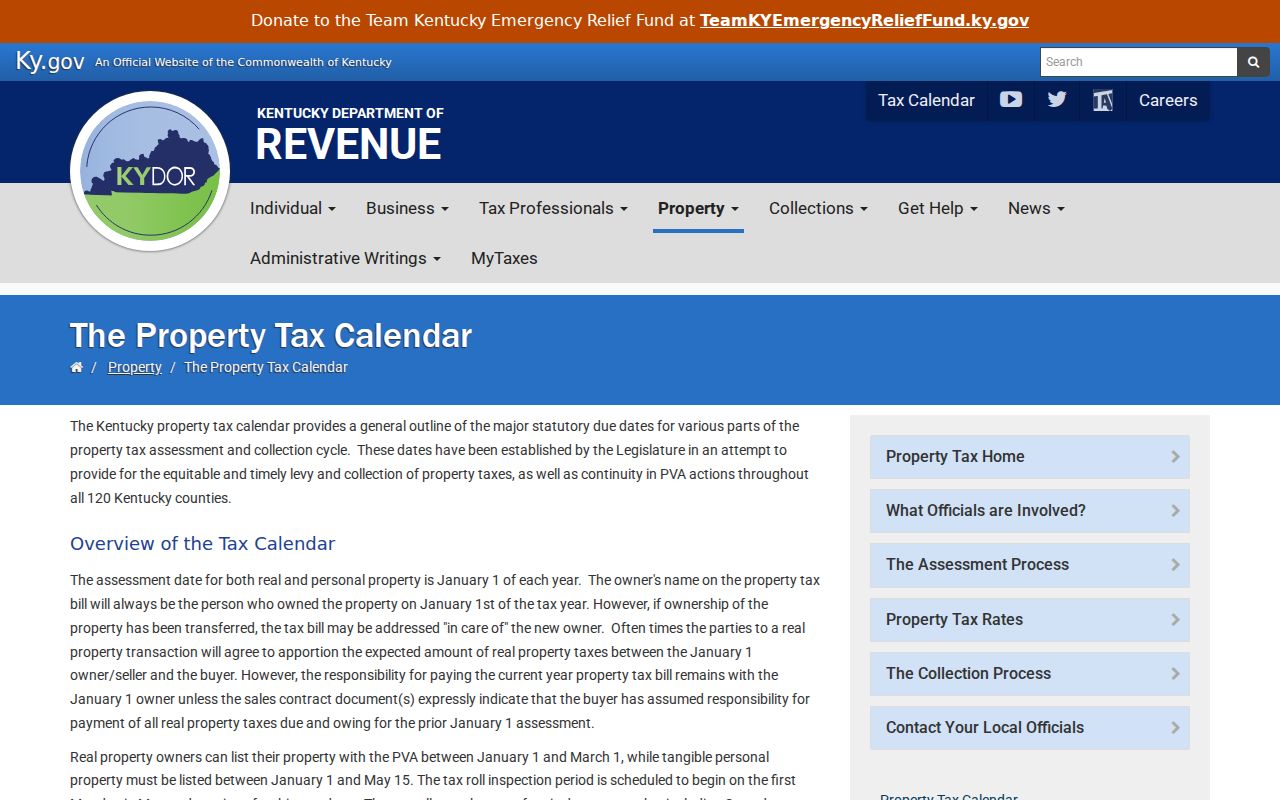
The statewide calendar sets the sequence. For any given year, the PVA must confirm the exact local inspection and petition dates before a taxpayer files.
Appeal window. Confer with the PVA first, then file the local-board petition by the next-workday deadline stated in the current Kentucky calendar.