
Build an Ohio County Ownership Timeline
The fastest entry point is the Ohio County Clerk eCCLIX route. It indexes recorded land instruments online. Coverage stops at an unpublished cutoff. Past that line, the Clerk's deed books take over. Supporting sources can solve name and address problems without ever substituting for deeds. Before tracing the first transfer, review the Clerk's online land-record instructions.
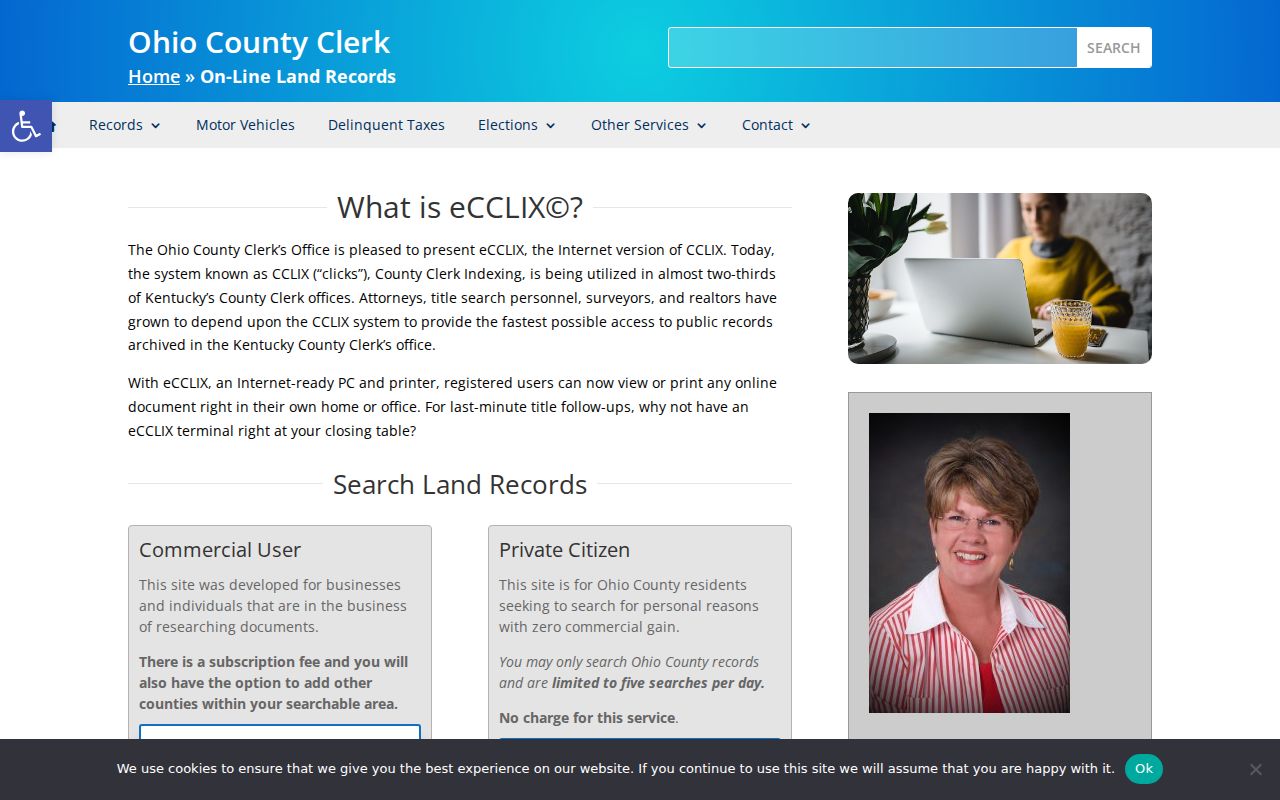
The captured county page explains eCCLIX access, while the ownership timeline still depends on matching each indexed instrument to the same tract.
| Source | Years It Covers | Where Held | What It Shows |
|---|---|---|---|
| eCCLIX deed index | Exact earliest year not published | Ohio County Clerk online | Parties, dates, types, recording references |
| Deed books and microfilm | Local volume run must be verified | Clerk and KDLA research room | Earlier transfers and legal descriptions |
| Recorded plats | Current and historic; exact run unverified | Clerk and planning files | Subdivision, lot, street, and dedication history |
| Tax assessment books | Historic runs vary | KDLA, Clerk, or library leads | Year-by-year ownership clues, especially before 1890 |
A recent sale starts with the newest deed. For nineteenth-century work, ask the Clerk or KDLA which deed and tax volumes survive before making the trip.
Start with Ohio County's Latest Grantee
The PVA's current owner name is just a launch point. Hunt the deed where that owner appeared as grantee. Whether the holder is a person, trust, estate, or company, record the transfer date, the grantor, the deed type, the legal description, and the book/page or document reference.
| Transfer Date | Grantor to Grantee | Instrument | Recording Locator |
|---|---|---|---|
| Newest verified date | Prior owner to current owner | Read the deed type | Book/page or instrument number |
| Earlier acquisition | Earlier owner to prior owner | Compare the legal description | Prior reference or index result |
| Older link | Repeat backward | Watch for fiduciary conveyance | Deed book and page |
Treat the timeline as a working ledger. Do not invent rows for owners of record. Fill each entry only from a verified index line or deed image tied to the parcel.
Walk the Ohio County Chain Backward
Walking the chain backward flips the roles at every step. The grantor named on one deed becomes the grantee. You then look for that name on an earlier deed. Test each name that way, deed after deed. The land description is what keeps the whole chain tied to the same property. So check it every time.
- Locate the newest acquisition deed and confirm the subject legal description.
- Copy the grantor exactly, including initials or an entity suffix.
- Search that grantor as a grantee in an earlier date range.
- Compare the parcel, acreage, adjoining owners, lot/block, and prior references.
- Repeat in physical or microfilmed indexes when the online records stop.
- Grantor and grantee
- The transferring and receiving parties named by an instrument.
- Chain of title
- The linked sequence of conveyances affecting the same land.
- Reverse index
- An index organized from the receiving-party side, useful for finding an acquisition.
- Legal description
- The tract language that can survive when an address or parcel number changes.
Search Past Owners Under Name Variants
Grantor and grantee indexes each need their own pass. Search surname-first, then initials, punctuation shifts, estate and trust styles, and company-name variants. Kentucky archival guidance adds H, C, and S prefixes for indexes that classify heirs, commissioner, and sheriff entries.
A commissioner deed can follow a judicial sale. A sheriff deed may follow a tax proceeding. An executor or administrator deed may follow probate. Once the related case or estate authority is identified, these stop looking like missing links in the chain.
Note: Match a repeated surname to the land description, not to any other Ohio County appearance.
Repair Ohio County Former-Owner Gaps
A gap does not mean a deed is missing. The transfer may sit under a different party style. Styles include an estate, trust, commissioner, sheriff, or corrected deed. Search the grantor and grantee sides both. Widen the date range. Compare each candidate's legal description before trusting a match. Initials, married names, entity suffixes, and spelling variants each deserve their own pass. Run each pass through the deed records.
If the online index runs dry, hand the Clerk the last verified book and page. Include party names, tract description, and date range. KDLA microfilm, tax books, recorded plats, and probate or court files can bridge the gap. Every name on the former-owner timeline should trace to a recorded instrument.
Note: For each link, log the office and volume or instrument locator, plus the exact tract clue used.
Use Tax Books Before 1890
Deeds recorded from about 1890 forward tend to cite their prior recording. The KDLA backward-chain method relies on those references. It walks a chain of title in reverse. Before that point, the trail often goes quiet. A deed may name no earlier book or page at all. When that happens, tax assessment books can bridge the gap. They carry ownership back through years when the deed record itself falls silent.
Treat a tax-list entry as a clue rather than a conveyance. It tells you who was assessed and when. It does not transfer title. Once the tax book suggests a likely owner and year, go back to the deed indexes. Test the match against acreage, watercourse, road, neighboring owners, or the lot description.
Probate Explains Some Ohio County Title Jumps
Not every transfer looks like a sale. Property can pass through survivorship, a life estate, heirs, an executor, or an administrator. Search the decedent's name, estate style, fiduciary, heirs, and spouse. When the underlying file matters, use the Kentucky court-record request process to pull the probate or court record.
Only the deed bridges back into the land chain. A docket entry or an obituary may explain family relationships. Neither proves how the tract passed.
When Subdivisions Changed the Address
Rolling Hills offers a documented Ohio County example. A Kentucky appellate opinion traces a 1963 purchase, staged development, and a 1966 Beaver Dam annexation. It even includes a November 10, 1966 plat lead. The later subdivision name never erased the parent-tract chain. The city label changed too, and the older ownership still held.
Use the Rolling Hills opinion to harvest dates and names. Then verify the recorded plat and deeds through the Clerk. Beaver Dam's 2024 annexation notice works the same way. It carries a legal description and an annexation-plat reference. That shows how newer boundary language can overlay older ownership.
Connect Old Occupants to Former Owners
The Ohio County Public Library genealogy collection brings together Browning local-history materials, newspapers, obituaries, and cemetery files. It also holds oral histories and historic maps. An old address found there can pin down the right years for a deed search. A household name can do the same. Fordsville adds its own house-history trail. The 1790 Mobberley home and the L&N Depot Museum both anchor properties to a period. A directory or newspaper may name an occupant who never held title, though. Carry every such discovery back to the deed books and tax lists for proof.
The genealogy annex sits at 424 Main Street in Hartford and works by appointment. Call ahead to confirm its schedule. The online Wednesday-hours listing looks inconsistent with what the library actually keeps.
Reach Ohio County Records Beyond eCCLIX
The Clerk counter at 301 South Main Street, Suite 201, in Hartford keeps weekday hours, Monday through Friday from 8:00 a.m. to 4:30 p.m. The Fordsville branch is open Tuesdays from 9:00 a.m. to 2:00 p.m. It closes from noon to 12:30 for lunch. For a known item, the Clerk's open-records policy accepts a signed request. Delivery, mail, fax, or email all work.
Microfilm from earlier decades may sit in the KDLA research room rather than at the counter. Ask for an Ohio County finding aid there. Request exact volume coverage too. The statewide 1781-2018 range describes the whole collection, not a promise about any particular local record.
How Far Back Ohio County Owners Can Be Traced
Ohio County publishes no confirmed starting date for its earliest deed book. It lists no first year covered by eCCLIX. It documents no courthouse-record loss either. So the honest stopping point is the last instrument you can verify. After that, ask the Clerk or KDLA directly about coverage. Resist the temptation to invent a fire gap. Fordsville's town history mentions fires, but that proves nothing about county deed records. Kentucky's broad deed-book range offers archival context, not evidence that every Ohio County volume survives.
Start with the Ohio County Clerk records page. The modern index may run dry at some point. KDLA and the library can push the search further back from there.
Lawful use. Research former owners for house history, estate work, purchase diligence, or title questions. Never use personal details to stalk, harass, or harm a living person.