
Read Ohio County Deed Records by Type
The Ohio County Clerk keeps the deed records for the county. The office also holds mortgages, releases, liens, and plats. The deed type tells you something. It hints at why a name joined the chain of title. That might be a sale, an inheritance, or a court-ordered transfer. Still, the type alone settles nothing. Only the full instrument spells out the details. It shows the interests and warranties that actually passed between the parties.
| Deed Type | What It Does | Common Use |
|---|---|---|
| Warranty deed | Conveys the described interest with stated covenants | Ordinary arm's-length transfer |
| Quitclaim deed | Conveys whatever interest the grantor has, if any | Family or corrective transfer |
| Special warranty deed | Uses warranties limited by the instrument | Transaction with narrower assurances |
| Executor or fiduciary deed | Transfers under estate or fiduciary authority | Probate-related conveyance |
| Commissioner or sheriff deed | Records a transfer arising from judicial or tax process | Sale ordered through a public proceeding |
Not every recorded document transfers ownership. A deed conveys an interest in the property. A mortgage or lien, by contrast, encumbers the land without moving title at all. A release recorded later can clear one of those encumbrances off the books. Before labeling any entry in the deed records, read the index category. Read the document itself, too.
The Ohio County Clerk Recording Route
The Clerk's online doorway is eCCLIX Online Land Records. Citizens get free access for Ohio County. It is capped at five searches a day for personal use. Commercial users buy a paid account instead. That tier can add other counties. It also permits online viewing and printing of recorded documents. Before running a query, gather both party names. Add a rough recording range and any book/page or document reference you have. One caution applies. The Clerk does not publish the earliest year covered by the online deed index. So an empty result never proves a deed went unrecorded. See the Clerk's current land-record access instructions.
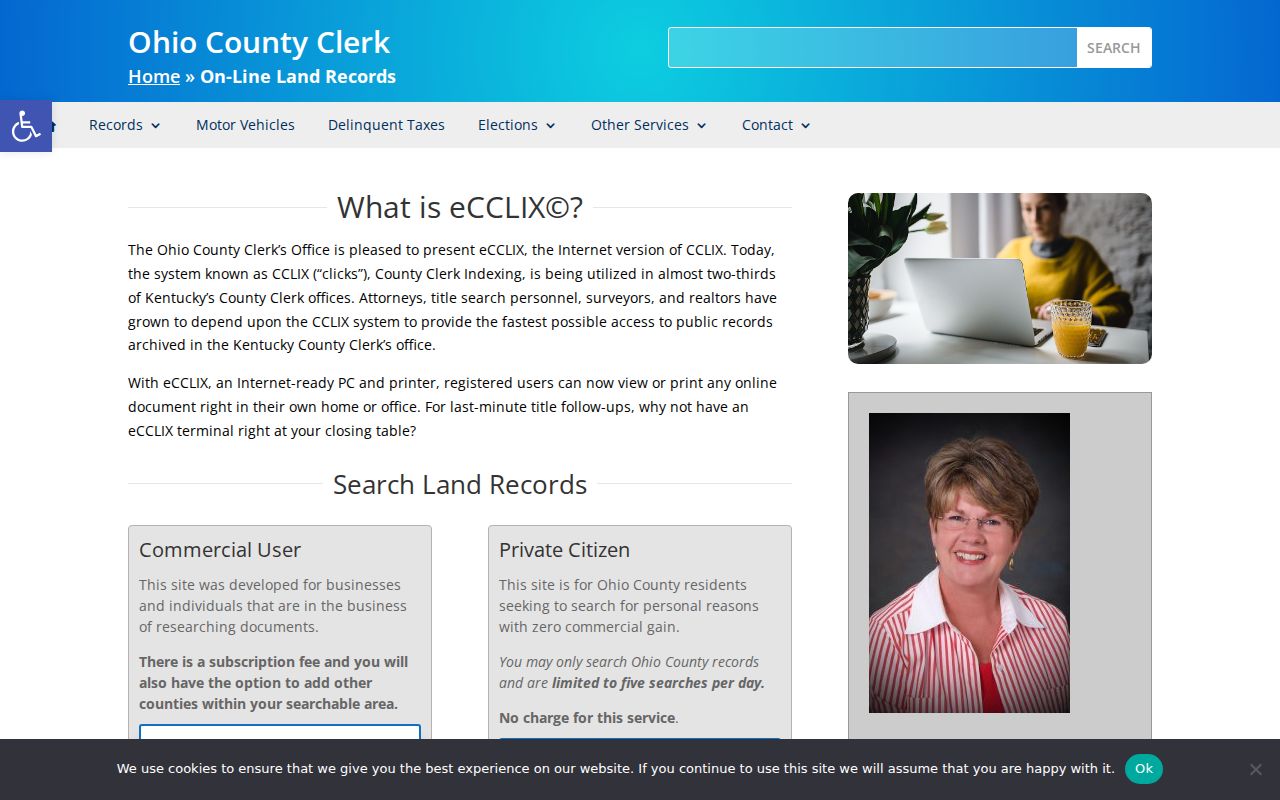
The captured page explains citizen and account access, which should be checked again before relying on a search limit or feature.
Fields to Test in the eCCLIX Deed Index
The eCCLIX deed index centers on a few core fields. A parcel number, a grantor or grantee name, and a recording date frame most searches.
| Search Element | Input | Why It Matters |
|---|---|---|
| Grantor or grantee | Person, estate, trust, or business name | Finds either side of a conveyance |
| Instrument type | Deed, mortgage, release, lien, or plat | Separates transfers from encumbrances |
| Recording range | Approximate dates or year | Reduces identical-name results |
| Book/page or document number | Reference from a deed or parcel record | Targets one recorded item |
Try surname variants and initials, since spellings drift across decades of deed records. Companies may appear with or without punctuation. Estates and trusts are often indexed under their full recorded style rather than a familiar personal name.
Follow Ohio County Grantors and Grantees
Every deed pairs two parties. The grantor transfers an interest. The grantee receives it. Reading those roles in both directions can reconstruct a full chain of title. That discipline keeps a mortgage or a release from being mistaken for a sale.
- Locate the current owner's acquisition with that owner indexed as grantee.
- Read the grantor, legal description, date, and any prior-recording reference.
- Search that grantor as an earlier grantee and compare the same land description.
- Repeat until the online coverage stops, then continue at the Clerk or in microfilm and deed books.
- Grantor
- The party transferring the recorded interest.
- Grantee
- The party receiving the recorded interest.
- Chain of title
- The linked sequence of instruments affecting the same land.
- Book/page or instrument number
- A locator for the official recording, not a parcel number.
When Ohio County Deeds Leave the Web
Statewide guidance comes from the Kentucky Department for Libraries and Archives. It places county deed-book holdings generally between 1781 and 2018. That range is broad, though, and says nothing about the first surviving Ohio County volume. The local eCCLIX cutoff, imaging date, and any gaps between volumes vary. Confirm coverage before counting on a historic deed search.
The KDLA deed-record handout advises running separate grantor and grantee searches. Modern deeds tend to cite prior recordings from about 1890 forward. Earlier chains may need tax assessment books to bridge gaps in ownership. Index prefixes like H, C, or S can flag heirs, commissioner, or sheriff entries. Heed those conventions only where they apply.
Note: Ask the Clerk or KDLA for the actual Ohio County volume and microfilm coverage before planning a historic property search.
Estate, Commissioner, and Sheriff Deeds
A clean buyer-to-seller sequence rarely survives probate intact. Land can pass through an estate, a court-ordered sale, or a delinquent-tax proceeding. Those transfers leave different paper. Search executor, administrator, estate, commissioner, and sheriff terms beside the party names you already have. Then pull the probate or court file behind it.
The Kentucky court-record request route keeps the actual files with the circuit court clerk. Archived files may need a locator number or a KDLA referral. A docket hit is only a starting point. It never substitutes for the recorded deed itself.
Commissioner and sheriff deeds may sit in the ordinary deed books. They may also sit in a separate run of volumes. KDLA recommends checking both the grantor and grantee indexes. It also suggests watching for H, C, or S prefixes where a county tagged heirs, commissioners, and sheriffs. Treat those letters as prompts to open the volume. They are not universal codes that fit every Ohio County entry.
Ohio County DOC ALERT Notices
The Clerk offers a free Ohio County DOC ALERT signup. Enter a name and an email address. The service then sends a notice whenever a mortgage or deed is recorded under that name for a selected person or business.
Its scope is deliberately narrow. It will not block a filing. It will not identify every beneficial owner. It will not settle whether title is valid. It is a nudge, not a clearance.
Register whichever personal or business-name forms are most likely to appear on an instrument. A notice is only the start. Compare the land description and recording details against the Clerk's index and the document image, especially when the name is common.
A Rolling Hills Deed and Plat Trail
Subdivision history rarely lives in one record. A Kentucky Court of Appeals opinion traces Rolling Hills from its 1963 purchase through staged development and annexation by Beaver Dam in 1966. A November 10, 1966 plat anchors the trail. The lesson is simple.
A thorough subdivision search braids developer names, deeds, plats, and city-boundary records together. Read the Rolling Hills appellate opinion for the full dates and names, and treat it as a lead rather than the recorded land instrument.
Request an Ohio County Deed Copy
Need a copy the online index does not show? Ask the Clerk at 301 South Main Street, Suite 201, Hartford. The open-records policy accepts signed requests by hand delivery, mail, fax, or email. Give a precise description. The office then has five working days, excluding weekends and holidays, to issue a written decision.
Fees are set by statute. Noncommercial paper copies run $0.50 each unless KRS 64.012 or 64.019 controls. Computer discs or tapes cost $5. Prepay fees plus postage. For recording questions, call (270) 298-4423. The Fordsville branch keeps a Tuesday counter from 9:00 a.m. to 2:00 p.m. It closes for lunch from noon to 12:30.
A good request leads with the book/page or document number. Party names help. So do the document type and an approximate recording date. Say plainly whether you want an ordinary copy or a certified one. An index printout rarely serves the purpose a requester has in mind. Precision also spares the Clerk from guessing among parties with similar names.
Treat the property address as a supporting clue only. Recorded deeds are indexed by parties and recording references, and older instruments may predate the modern street address. A subdivision parcel calls for the subdivision, lot, and block. For a rural tract, add the acreage, route, watercourse, adjoining-owner language, or the short legal description copied from the assessment record.
Read the returned image from start to finish. Check the execution and recording dates. Verify every grantor and grantee, the deed type, any consideration language shown, and the full legal description. Reservations, easements named in the instrument, and the preparer or return address deserve the same scrutiny. A marginal or prior-reference notation often supplies the next link backward. If an attachment is missing or illegible, ask whether another image, a deed-book scan, or an in-person volume exists. Do not assume the chain has a gap before asking.
Electronic filing is a separate track. The Clerk names Simplifile, CSC, and ePN as approved eRecording vendors for deeds, mortgages, and releases. Submitting that way is not a public search or copy request. Once accepted, a transmitted document still must be checked in the official index. The recording date, book/page or instrument number, and indexed party roles remain the reliable keys. Use them for citing it later.
Not everything is released like an ordinary deed. Kentucky treats military discharge records as confidential, and the Open Records Act allows other exemptions and redactions. Describe the exact public land instrument needed and let the custodian apply the rule. A denied or limited request should state its legal basis. It is not proof that no record exists.
Recorded, not guaranteed. Ohio County deed records show instruments accepted for recording; they do not resolve every defect, unrecorded interest, or boundary conflict.