
Distinguish Ohio County Property Values
Name the number first. Kentucky assesses real property at 100% of fair cash value under KRS 132.191, yet a public assessment is still not the same record as an actual sale. A deed can state consideration when that field is available. The PVA card, meanwhile, may break out land and improvements separately.
| Value type | Meaning | Official record |
|---|---|---|
| Assessed value | PVA tax-roll value under Kentucky's standard | Ohio County PVA |
| Market evidence | Sales, cost, or income evidence used in valuation | PVA assessment process |
| Last sale price | Consideration for a specific transfer, if displayed | County Clerk deed or verified sales field |
| Land and improvements | Separate components that may explain the total | PVA card, if shown |
Keep the source and the year beside every figure. Sales can be unusual. Assessments can carry a different valuation date. An exemption may change taxable exposure without touching the underlying value evidence at all.
Ohio County Property Value Standard
KRS 132.191 sets Kentucky's fair-cash-value standard. State guidance describes a fair voluntary sale and recognizes sales comparison, cost, and income methods. Which method fits depends on the property type and the facts at hand, so no single formula should be inferred from a parcel card. A residence may lean on comparable sales. A specialized building can require cost evidence. Income-producing property can call for income evidence instead. These are alternate valuation approaches, not public prices to add together.
- Assessed value
- The value carried on the PVA roll.
- Fair cash value
- Kentucky's statutory standard tied to a fair voluntary sale.
- Sale consideration
- The amount tied to a recorded transfer when displayed.
- Reassessment
- A later review that can change the roll as facts and evidence change.
Ohio County Revalues Property Each Year
The Kentucky DOR assessment process requires real property to be revalued annually. It must also be physically inspected at least once every four years. That cycle explains why two tax years can differ. A difference can show up even when no ordinary deed transfer occurred. An annual revaluation does not mean staff visits each parcel every year. The four-year physical inspection is separate. Improvements, corrected characteristics, and newer market evidence can also move the tax roll. Ohio County publishes no local revaluation impact table. Values must therefore be checked parcel by parcel. Review Kentucky DOR's real-property valuation resources for the state rules behind the county assessment.
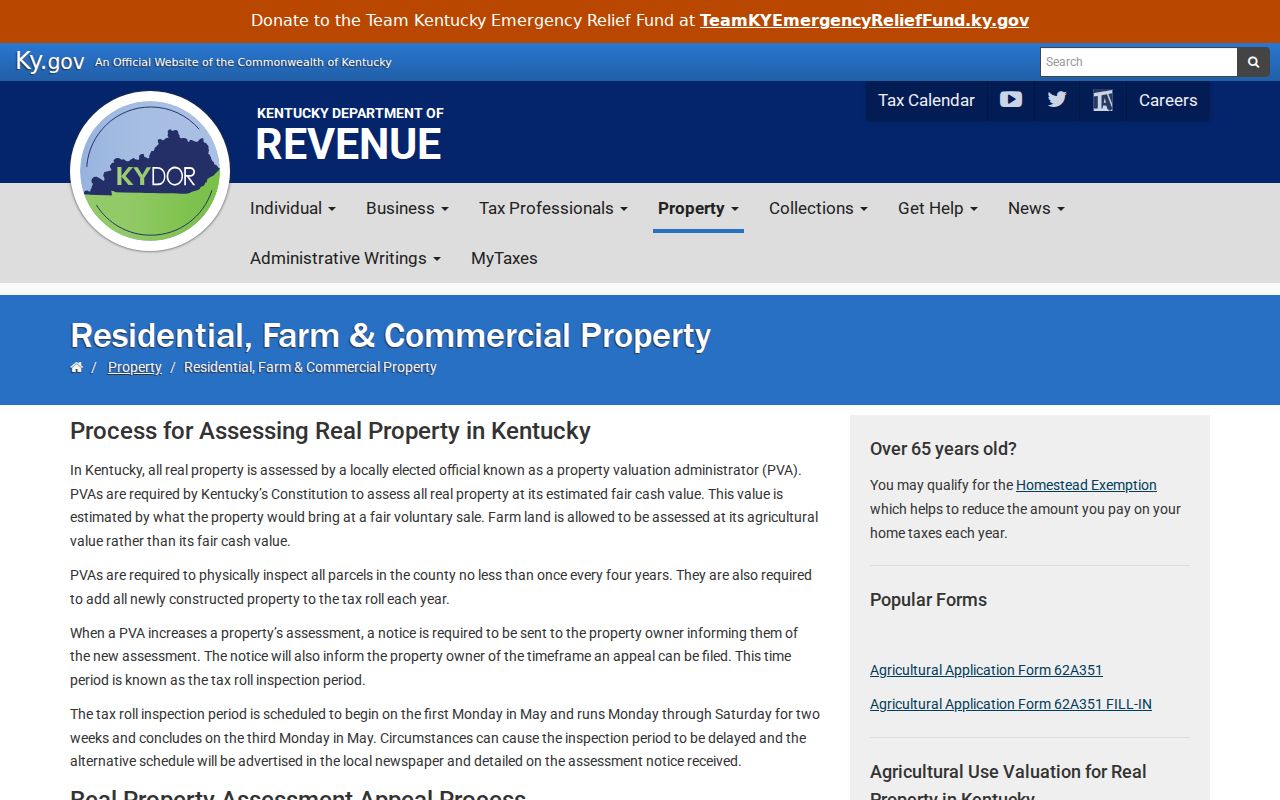
The state resource supplies the valuation context. The Ohio County PVA card remains the source for a parcel's dated assessed value. Note: Compare assessments from the same year before drawing any conclusion about relative value or change.
Look Up an Ohio County Property Value
The official starting point is the Ohio County PVA qPublic application. Field layouts can change, so do not assume every expected item appears. Confirm parcel identity before value.
- Enter the situs address with route, suffix, and directional variants if needed.
- Match owner, location, legal description, and parcel ID before reading value.
- Record the year and any land, improvement, total, exemption, or sales fields shown.
- Verify any sale figure in the Ohio County Clerk's recorded deed.
- Situs address
- The physical location used to identify the parcel.
- Mailing address
- The destination for tax correspondence, which may be elsewhere.
- Parcel ID
- The exact local key carried across assessment and map records.
A PSC filing reproduces a local qPublic result showing parcel 141-37 & 38A, location 6109 US HWY 231 S, and a Primary Owner line. It proves compound IDs and route-style addresses occur locally. It does not supply a current property value.
Read Ohio County Property Value Fields
Card fields you may see include land value, improvement value, total assessed value, an exemption indicator, legal description, acreage, characteristics, sales information, and a map. The exact field set varies. Report only what the opened card actually shows.
| Land | The site component, if stated separately |
|---|---|
| Improvements | Buildings or other assessed additions, if stated |
| Total | The roll figure combining relevant assessed components |
| Year | The essential time label for a sound comparison |
| Exemption flag | A tax-treatment clue, not a new market estimate |
If qPublic is unavailable, contact the PVA. The address is 301 South Main Street, Hartford. Call (270) 298-4433, fax (270) 298-4435, or write P.O. Box 187, Hartford, KY 42347. Those channels are the official fallback for a current assessment card.
Read an exemption flag apart from the underlying assessment. Kentucky's homestead or disability treatment can change taxable exposure. It does not turn the parcel card into a second market estimate. For a clean Ohio County property value comparison, record the gross assessed figure and the value year. Keep any exemption line as a distinct fact. Labels on the screen may be unclear. Ask the PVA which field represents the assessed total. Do that before comparing it with another parcel or a deed price.
Compare Ohio County Property Values by Year
A sound comparison holds the parcel and value type constant. Start with the same Ohio County parcel ID. Then record the assessment year, land component, improvement component, total, and any exemption flag for each available year. A change in the total can reflect a new improvement. It can also reflect corrected parcel facts, updated market evidence, or the annual revaluation process itself. It does not, by itself, prove the property sold or that its condition changed.
Next, separate assessment dates from transfer dates. The Sheriff identifies January 1 as the assessment date. Deeds can be recorded throughout the year. A late-year sale and a roll value for the next assessment cycle are not observations from the same day. Keep both dates beside the figures so timing never becomes a false discrepancy.
An older value may not be visible online. In that case, request the applicable assessment card or roll entry from the PVA. Ask for the year and parcel ID precisely. The county publishes no complete online value-history coverage range. So treat an absent year as an access gap, not as proof that no assessment exists.
Verify Ohio County Sale Price in the Deed
The Ohio County Clerk eCCLIX page lets you search a transfer by grantee, grantor, date, and record reference. Private-citizen access is free for personal use. It covers Ohio County only. Searches cap at five per day. Registered users can view and print available documents.
Read the consideration only when the deed shows it, then match the legal description and parcel reference before trusting the number. A fiduciary, quitclaim, commissioner, or sheriff deed can reflect circumstances that make its stated amount a poor stand-in for open-market value. The deed records what happened. It does not create a current appraisal.
Note: A sale field without a matching instrument, legal description, and transfer context can mislead more than it informs.
Ohio County Property Assessment Evidence
The Kentucky property-tax calendar pinpoints the conference and appeal cycle. Its evidence examples help explain a value. Physical characteristics, insurance information, construction costs, and sales listings all connect the figure to facts more directly than a bare comparison with an unrelated parcel.
This page stops at value meaning. For the annual bill, exemptions, collection dates, and contest steps, use the Ohio County property tax records guide. That split keeps value and tax questions separate.
Limits of an Ohio County Property Value
A public value does not inspect current interior condition, resolve title, prove lot lines, or predict a willing buyer's offer. The record can lag badly. Assessment timing, renovations, exemptions, parcel splits, and unusual transfers all widen that gap from a present private appraisal.
Value versus price. Ohio County assessed value is maintained for tax purposes and does not guarantee what the property would sell for today.
Treat the PVA figure as an official dated record. Treat the deed as evidence of one transfer. For a market opinion tied to present condition and purpose, obtain a qualified appraisal rather than relabeling either public number.